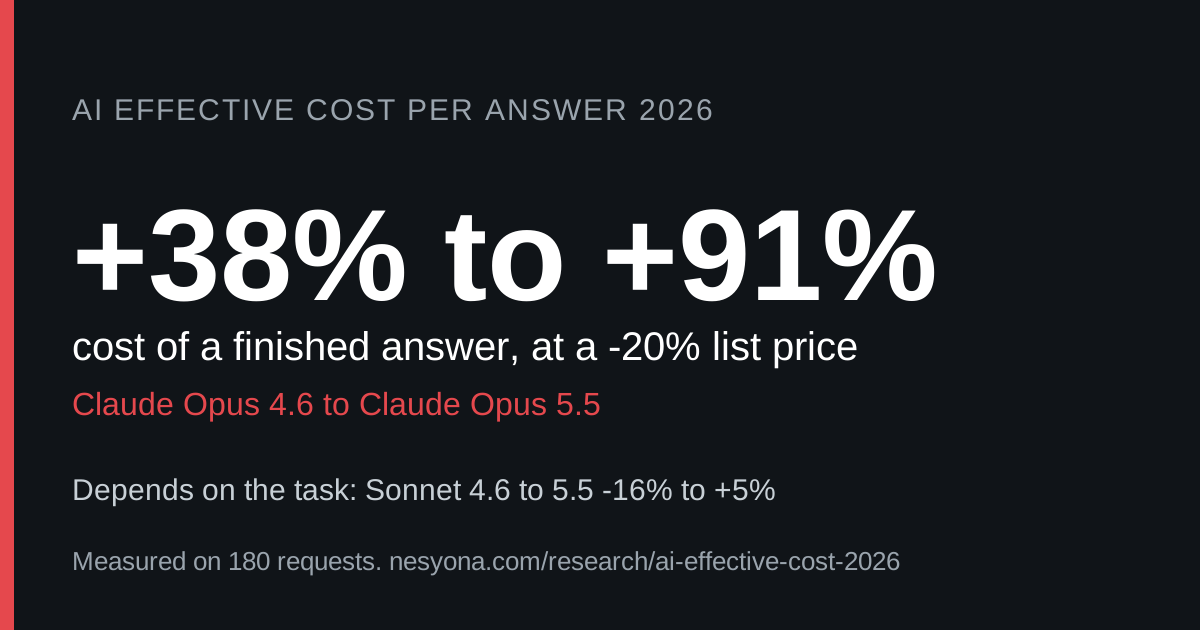
Claude Opus 4.6 to Claude Opus 5.5: the list price fell 20%, the cost of a finished answer rose 38% to 91%
We asked 9 Claude models two batteries of requests, 60 ordinary ones and 120 across code, summarising, long-form writing and reasoning, and priced the tokens they actually used at the provider-stated list prices. From Claude Opus 4.6 to Claude Opus 5.5, the price per token fell 20% while the cost of a finished answer rose 38% to 91% depending on the task; at an unchanged price, Opus 4.6 to 4.7 rose 26% to 39%. For Sonnet 4.6 to 5.5 the sign flips with the task: code and reasoning got cheaper, long-form writing dearer. Measured, with intervals, and every answer's tokens saved.
In this article
The headline, measured
We asked 9 Claude models two batteries of requests (60 ordinary requests, and 120 across code, summarising, long-form writing and reasoning) and priced what they actually used. From Claude Opus 4.6 to Claude Opus 5.5 the list price per token fell 20% and the cost of a finished answer rose 38% to 91%, depending on the task mix. Between Opus 4.6 and 4.7 the list price did not move and the cost of an answer rose 26% to 39%. For Sonnet the sign changes with the task: -16% to +5%.
Cost of a finished answer at list price on two batteries (+38% on 120 task-typed requests, +91% on 60 ordinary ones). The list price per token changed -20%.
At an unchanged list price: +26% on the ordinary requests, +39% on the task-typed battery. The same step counted +47% more input tokens.
List price -33%. The sign depends on the task: code -32%, reasoning -34%, long-form writing +12%.
9 Claude models, two runs of 60 requests. Every answer has its tokens and cost in answers.csv.
Bars: cost of 1,000 finished answers at list price, run 2 (4,000-token cap). Claude Haiku 5.5 is not shown because its list price is not in the archived tables.
Every step inside each model line
The change in list price, in input tokens (the tokenizer) and in output tokens (how much the model writes), and what they do together to the cost of a finished answer. A step whose interval spans zero is not a clear change.
| Step | List price, output | Input tokens | Output tokens (run 2) | Cost per answer (run 2) | 95% interval | Cost per answer (run 1) |
|---|---|---|---|---|---|---|
| Claude Opus 4.6 to Claude Opus 4.7 | 0% | +47% | +26% | +26% | +7% to +52% | +43% |
| Claude Opus 4.7 to Claude Opus 4.8 | 0% | -12% | -1% | -2% | -6% to +4% | -1% |
| Claude Opus 4.6 to Claude Opus 5.5 | -20% | +36% | +140% | +91% | +57% to +133% | +73% |
| Claude Sonnet 4.6 to Claude Sonnet 5.5 | -33% | +36% | +57% | +5% | -10% to +28% | +7% |
| Claude Haiku 4.5 to Claude Haiku 5.5 | n/a | +36% | +137% | n/a | n/a | n/a |
It depends on what you ask: a second battery
The first battery was 60 ordinary requests, and its result did not hold in size on a different mix. So we added 120 requests in four task types (30 each of code, summarising a real article passage, a 400-word explanation and short reasoning), answered by the same 9 models with a 4,000-token cap and no answer cut off. These are constructed requests, task templates crossed with topic lists, not real user prompts.
Opus 4.6 to 5.5 rose +38% here against +91% on the ordinary requests, so the direction held and the size did not. Sonnet 4.6 to 5.5 changed -16% overall, and the sign depends on the task: -32% for code, -34% for short reasoning and +12% for long-form writing.
| Step | List price, output | Cost per answer, all 120 | 95% interval | Code | Summarising | Long-form writing | Short reasoning |
|---|---|---|---|---|---|---|---|
| Claude Opus 4.6 to Claude Opus 4.7 | 0% | +39% | +34% to +43% | +27% | +26% | +42% | +74% |
| Claude Opus 4.7 to Claude Opus 4.8 | 0% | -1% | -3% to +1% | +5% | -2% | -2% | -8% |
| Claude Opus 4.6 to Claude Opus 5.5 | -20% | +38% | +30% to +46% | +34% | +29% | +35% | +63% |
| Claude Sonnet 4.6 to Claude Sonnet 5.5 | -33% | -16% | -22% to -9% | -32% | 0% | +12% | -34% |
Percentage change in cost per answer at list price, battery 2. The 95% interval is a paired bootstrap over the 120 requests; per-task cells hold 30 requests each and are wider.
| Model | Code, cost per answer | Summarising, cost per answer | Long-form writing, cost per answer | Short reasoning, cost per answer | All 120 | Mean output tokens | Of which thinking |
|---|---|---|---|---|---|---|---|
| Claude Haiku 4.5 | $0.00269 | $0.00090 | $0.00272 | $0.00102 | $0.00183 | 349 | 0 |
| Claude Haiku 5.5 | n/a | n/a | n/a | n/a | n/a | 592 | 137 |
| Claude Sonnet 4.6 | $0.0121 | $0.00284 | $0.00805 | $0.00346 | $0.00660 | 423 | 0 |
| Claude Sonnet 5.5 | $0.00819 | $0.00284 | $0.00900 | $0.00228 | $0.00558 | 534 | 61 |
| Claude Opus 4.6 | $0.0136 | $0.00492 | $0.0144 | $0.00498 | $0.00949 | 362 | 0 |
| Claude Opus 4.7 | $0.0173 | $0.00619 | $0.0205 | $0.00865 | $0.0132 | 503 | 0 |
| Claude Opus 4.8 | $0.0182 | $0.00608 | $0.0200 | $0.00795 | $0.0131 | 500 | 0 |
| Claude Opus 5.5 | $0.0183 | $0.00637 | $0.0194 | $0.00813 | $0.0131 | 629 | 91 |
| Claude Fable 5.1 | $0.0331 | $0.0137 | $0.0430 | $0.00984 | $0.0249 | 474 | 29 |
Why the bill moved: three causes
A finished answer costs more or less for three separate reasons, and they can point in opposite directions. The tokenizer: the same text counts as more tokens on a newer model. Visible writing: the newer model writes a longer or shorter answer. Hidden thinking: some newer models spend billed output tokens on thinking that never appears in the answer. We split the change in output tokens into these three using the free token-count endpoint and the thinking-token count the API reports.
| Step | Tokenizer (same text, newer tokenizer) | Visible writing (how much the model writes) | Hidden thinking (billed, not shown) | The three together | Output tokens, provider-reported |
|---|---|---|---|---|---|
| Claude Opus 4.6 to Claude Opus 4.7 | +42% | -11% | 0% | +26% | +26% |
| Claude Opus 4.7 to Claude Opus 4.8 | 0% | -1% | 0% | -1% | -1% |
| Claude Opus 4.6 to Claude Opus 5.5 | +42% | +40% | +19% | +136% | +140% |
| Claude Sonnet 4.6 to Claude Sonnet 5.5 | +43% | -2% | +15% | +61% | +57% |
| Claude Haiku 4.5 to Claude Haiku 5.5 | +45% | +29% | +27% | +137% | +137% |
Opus 4.6 to 4.7 is the clean case: the tokenizer alone would raise output tokens by +42%, but 4.7 writes 11% less text, so the net is +26%. The 5.5 steps add a third cause: a share of their billed output is hidden thinking.
| Model | Mean billed output tokens | Of which thinking | Thinking share | Answers that used thinking |
|---|---|---|---|---|
| Claude Haiku 4.5 | 319 | 0 | 0.0% | 0 of 60 |
| Claude Haiku 5.5 | 768 | 164 | 21.3% | 28 of 60 |
| Claude Sonnet 4.6 | 502 | 0 | 0.0% | 0 of 60 |
| Claude Sonnet 5.5 | 772 | 98 | 12.7% | 14 of 60 |
| Claude Opus 4.6 | 450 | 0 | 0.0% | 0 of 60 |
| Claude Opus 4.7 | 559 | 0 | 0.0% | 0 of 60 |
| Claude Opus 4.8 | 552 | 0 | 0.0% | 0 of 60 |
| Claude Opus 5.5 | 1,050 | 169 | 16.1% | 60 of 60 |
| Claude Fable 5.1 | 760 | 33 | 4.3% | 13 of 60 |
Thinking was measured on a separate recapture of the same 60 prompts. The three oldest models report no thinking count; they show 0 because no thinking block came back in any of their 60 answers. The three-way figure matches the provider-reported change to within about four points.
Every model
Mean input and output tokens per answer over the 60 requests, the provider-stated list price, and the cost per answer in each run.
| Model | List price, $ per million tokens (in / out) | Mean input tokens | Mean output tokens (run 2) | Answers cut off at 4,000 tokens | Cost per answer, run 2 | Cost per answer, run 1 |
|---|---|---|---|---|---|---|
| Claude Haiku 4.5 | $1 / $5 | 28 | 318 | 0 of 60 | $0.00161 | $0.00146 |
| Claude Haiku 5.5 | n/a | 38 | 754 | 1 of 60 | n/a | n/a |
| Claude Sonnet 4.6 | $3 / $15 | 28 | 490 | 1 of 60 | $0.00743 | $0.00596 |
| Claude Sonnet 5.5 | $2 / $10 | 38 | 771 | 1 of 60 | $0.00779 | $0.00639 |
| Claude Opus 4.6 | $5 / $25 | 28 | 444 | 1 of 60 | $0.0112 | $0.00929 |
| Claude Opus 4.7 | $5 / $25 | 41 | 559 | 0 of 60 | $0.0142 | $0.0133 |
| Claude Opus 4.8 | $5 / $25 | 36 | 550 | 0 of 60 | $0.0139 | $0.0132 |
| Claude Opus 5.5 | $4 / $20 | 38 | 1,066 | 2 of 60 | $0.0215 | $0.0160 |
| Claude Fable 5.1 | $10 / $50 | 38 | 731 | 1 of 60 | $0.0369 | $0.0295 |
The files
| File and hash | What it holds | Size |
|---|---|---|
data.jsonsha256 221a18cdc7b4 | Per-model token means, cost per answer in both runs, transitions with intervals, method and limits | 31 KB |
answers.csvsha256 2478a4d3a52d | Every answer's input tokens, output tokens, stop reason and cost, both batteries (2,160 rows) | 108 KB |
battery2.jsonlsha256 82096f193f65 | The 120 task-typed requests of battery 2, with their categories and the source article of each summarising passage | 47 KB |
decomposition.jsonsha256 631f2f2a255b | The split of the output-token change into tokenizer and visible writing, from the free token-count endpoint | 1.7 KB |
METHOD.mdsha256 88fa4e8733d6 | The method | 970 B |
METHOD.sha256sha256 76914909af6c | The SHA-256 of the method | 76 B |
README.mdsha256 0dc552bf3632 | Plain-language summary and limits | 3.6 KB |
share-card.svgsha256 3f10c0101fbe | A 1200 by 630 share image generated from the data | 1.2 KB |
How to cite it
Couey, V. W. (2026). AI effective cost per answer 2026: what a finished answer costs, not what a token costs. Nesyona. https://nesyona.com/research/ai-effective-cost-2026/ (edition 28 October 2026). https://doi.org/10.5281/zenodo.23748727. To cite every version: https://doi.org/10.5281/zenodo.23748726.
Cite the edition date and the file hash for a specific figure.
How it is built, and what it does not cover
Battery 1 is 60 ordinary requests, the frozen battery of the Decay Index. Battery 2 is 120 constructed task-typed requests (battery2.jsonl). Prices are the provider-stated list prices archived by AI Price Watch. Full method: METHOD.md.
Why every headline is a range. A figure from one design is a figure about that design. The headline spans every usable design in data.json (the 60 ordinary requests at a 4,000-token cap, and the 120 task-typed requests), and the first capture at a 1,200-token cap is shown but not used because it cut off up to a third of some models' answers. A design counts as usable when no model in the step had more than 5% of its answers cut off; that line was set after we saw the counts, so it is a disclosed choice, not a pre-declared one. The page generator refuses to print a range that differs from the one derived in the data file.
Closure checks. The three-cause split rebuilds the provider-reported change in output tokens to within 3.9 points on every step, and the residuals are in the data file. answers.csv holds all 2,160 answers, as counted. Thinking tokens never exceed billed output tokens.
- Battery 2 is 120 constructed requests (30 each of code, summarising, long-form explanation and short reasoning), not real user prompts: task templates crossed with topic lists, with real article paragraphs as the passages to summarise. It was added because the first battery of 60 was thin and its result did not hold in size on a different mix.
- Cost per answer is the measured mean input and output tokens priced at list price. It is not a bill: caching, batch discounts, reasoning tokens and plan limits are ignored.
- It measures what answers cost, not how good they are. A longer answer can be a better answer; this dataset does not say.
- One battery of 60 ordinary requests, one capture per model per run, Claude models only. Run 1 is the frozen Decay Index capture (1,200-token cap, so some long answers were cut off); run 2 raised the cap to 4,000 and is the headline.
- Run 2 was captured before this method note was written, so the method was not committed in advance and this is not a pre-registered study.
- Temperature was 0 where the model accepted it and the provider default otherwise; it is recorded per answer. There is no clean run-to-run noise estimate because every model was cut off at least once in run 1; uncertainty is the paired bootstrap interval over prompts.
- Hidden thinking tokens are billed inside output_tokens. Their share was measured on a separate recapture of the 5.x models only; for the three oldest models the API reports no thinking count and thinking is taken as 0 because no thinking block was returned. The cost figures use the provider-reported output tokens, so they include thinking.
- Claude Haiku 5.5 has no list price in the archived tables, so it has token counts but no cost per answer; no price was guessed.
- Only input and output tokens of this battery are priced. The ratio between input and output depends on the task; short prompts with long answers (as here) make output price dominate.
Related work. Cost per task rather than per token is also published by Artificial Analysis, and the Opus 4.7 tokenizer effect on real traffic has been measured by OpenRouter and others. This dataset does not replace them. It adds the rows (every answer's tokens and cost, openly licensed), intervals, and a split of the change into tokenizer, visible writing and hidden thinking on a fixed battery.
No provider was asked to comment before publication. A provider or reader who finds a wrong figure can tell us; we correct it and date the correction.
FAQ
What is effective cost per answer?
The list price per token tells you what a token costs. A finished answer costs the tokens it takes: the prompt tokens plus however many tokens the model writes back. Effective cost per answer is the measured mean of both, priced at the provider-stated list price. It is what you pay for the same request, not what the price list says.
What did you find?
Claude Opus 4.6 to Claude Opus 5.5: the list price per token changed -20% while the cost of a finished answer rose 38% to 91%, depending on the task mix: +91% (95% interval +57% to +133%) on 60 ordinary requests and +38% (+30% to +46%) on 120 requests across code, summarising, long-form writing and reasoning. Claude Opus 4.6 to Claude Opus 4.7: the list price did not change and the cost rose 26% to 39%. Claude Sonnet 4.6 to Claude Sonnet 5.5: list price -33%; on the ordinary requests the cost changed +5% (-10% to +28%) and on the task-typed battery -16% (-22% to -9%), cheaper for code and reasoning and dearer for long-form writing. Claude Opus 4.7 to Claude Opus 4.8: no clear change on either battery.
Why does the cost per answer move when the price does not?
Three things change it: how many tokens the same text counts as (the tokenizer, measured in the AI Tokenizer Inflation Ledger), how much the model visibly writes, and how many billed tokens go on thinking that is not shown. Output tokens are priced several times higher than input tokens, so a model that writes longer answers costs more per answer at the same list price.
What is hidden thinking?
Some newer models think before they answer. The provider bills those thinking tokens as output tokens even when the thinking is not shown in the answer. The API reports how many (output_tokens_details.thinking_tokens). On this battery the share of billed output that was thinking ranged from 0.0% to 21.3% across the nine models measured; the 4.x models returned no thinking at all.
Does a higher cost per answer mean a worse deal?
No. This dataset measures what answers cost, not how good they are. A longer answer can be a better one. It is a measurement of cost, not value.
Why two runs?
Run 1 is the frozen Decay Index capture with a 1,200-token cap, which cut off some long answers and so understated the cost of the most verbose models. Run 2 repeated the same 60 requests with a 4,000-token cap and is the headline. Both are shown.
How uncertain are the numbers?
Each step carries a 95% interval from a paired bootstrap over the prompts. The two batteries disagree on the size of some steps, which is why the headline is a range: the task mix moves the answer by more than the sampling interval within either battery. One capture per model per battery means there is no separate run-to-run estimate.
Why is Claude Haiku 5.5 missing a cost?
Its list price is not in the archived provider tables, so it has token counts and no cost per answer. No price was guessed.
Can I reuse it?
Yes. It is published under CC BY 4.0: reuse is free with attribution to Vincent Wesley Couey and a link to this page.
Does it have a DOI?
Yes. Version 1 is https://doi.org/10.5281/zenodo.23748727. The DOI for all versions is https://doi.org/10.5281/zenodo.23748726.