How much AI does $20 actually buy? The plan against the API, to the task
A $20 AI plan buys about 19 to 95.2 chat answers a day at the provider's top-model API list price, and about 95.2 a day at its mid model. Use less than that and the API is cheaper; use more and the flat plan is. Prices are the providers' own, read 28 October 2026. Set your own use below.
In this article
The short answer
A $20 AI plan buys about 19 to 95.2 chat answers a day at the provider's top-model API list price, and about 95.2 a day at its mid model. Use less than that and the API is cheaper; use more and the flat plan is.
Consumer plans whose price was read from the provider page. 3 providers have an API price on file for the join.
Every plan against a small, mid and top model at three declared task sizes, all in break-even.csv.
What $20 buys at a top-model API list price, across the three $20 plans.
Price changes the providers state in advance that change the maths from a stated date.
Try your own use
Set how many tasks you do a day, the kind of task and the size of model, and see what the same use costs at the provider's API list price against the flat plan. The table below is already set to 20 chat answers a day at a mid-size model.
| Plan | Plan per month | API model used | Same use at API list prices, per month | Cheaper |
|---|---|---|---|---|
| OpenAI Go | $8 | gpt-6.1-sol | $4.20 | API cheaper |
| OpenAI Plus | $20 | gpt-6.1-sol | $4.20 | API cheaper |
| OpenAI Pro (from) | $100 | gpt-6.1-sol | $4.20 | API cheaper |
| Anthropic Pro | $20 | Claude Sonnet 5.5 | $4.20 | API cheaper |
| Anthropic Max (from) | $100 | Claude Sonnet 5.5 | $4.20 | API cheaper |
| Google Google AI Plus | $4.99 | gemini-3.6-flash | $1.58 | API cheaper |
| Google Google AI Pro | $19.99 | gemini-3.6-flash | $1.58 | API cheaper |
| Google Google AI Ultra | $99.99 | gemini-3.6-flash | $1.58 | API cheaper |
| Google Google AI Ultra | $200 | gemini-3.6-flash | $1.58 | API cheaper |
Break-even, plan by plan
Chat answers a day (1,000 tokens in, 500 out) that each plan's monthly price buys at the provider's API list price. Below that use the API is cheaper; above it the flat plan is. Higher plans are "from" prices.
| Plan | Price per month | Small model: chat answers a day | Mid model: chat answers a day | Top model: chat answers a day |
|---|---|---|---|---|
| OpenAI Go | $8 | 761.9 gpt-6-luna | 38.1 gpt-6.1-sol | 7.6 gpt-6-astra |
| OpenAI Plus | $20 | 1904.8 gpt-6-luna | 95.2 gpt-6.1-sol | 19 gpt-6-astra |
| OpenAI Pro | $100+ | 9523.8 gpt-6-luna | 476.2 gpt-6.1-sol | 95.2 gpt-6-astra |
| Anthropic Pro | $20 | 190.5 Claude Haiku 4.5 | 95.2 Claude Sonnet 5.5 | 19 Claude Fable 5.1 |
| Anthropic Max | $100+ | 952.4 Claude Haiku 4.5 | 476.2 Claude Sonnet 5.5 | 95.2 Claude Fable 5.1 |
| Google Google AI Plus | $4.99 | 107.3 gemini-3.5-flash-lite | 63.4 gemini-3.6-flash | 23.8 gemini-4-argon |
| Google Google AI Pro | $19.99 | 429.9 gemini-3.5-flash-lite | 253.8 gemini-3.6-flash | 95.2 gemini-4-argon |
| Google Google AI Ultra | $99.99 | 2150.3 gemini-3.5-flash-lite | 1269.7 gemini-3.6-flash | 476.1 gemini-4-argon |
| Google Google AI Ultra | $200 | 2150.3 gemini-3.5-flash-lite | 1269.7 gemini-3.6-flash | 476.1 gemini-4-argon |
Provider reference points: Anthropic small Claude Haiku 4.5 ($1 in, $5 out), mid Claude Sonnet 5.5 ($2, $10), top Claude Fable 5.1 ($10, $50); OpenAI small gpt-6-luna ($0.1 in, $0.5 out), mid gpt-6.1-sol ($2, $10), top gpt-6-astra ($10, $50); Google small gemini-3.5-flash-lite ($0.3 in, $2.50 out), mid gemini-3.6-flash ($0.75, $3.75), top gemini-4-argon ($2, $10). USD per million tokens. Mistral's plans have no API price on file here.
Price changes the providers have scheduled
- Google gemini-3.6-flash: $0.75 in and $3.75 out per million tokens today; the provider's page says $1.50 and $7.50 after the change ($0.75 through December 31, 2026. $1.50 starting January 1, 2027. | $3.75 through December 31, 2026. $7.50 starting January 1, 2027.). At that price the same flat plan covers about half as many tasks.
- Google gemini-4-argon: $2 in and $10 out per million tokens today; the provider's page says $4 and $20 after the change ($2.00 through November 30, 2026. $4.00 starting December 1, 2026. | $10.00 through November 30, 2026. $20.00 starting December 1, 2026.). At that price the same flat plan covers about 47.6 chat answers a day on Google AI Pro instead of 95.2.
The files
| File and hash | What it holds | Size |
|---|---|---|
data.jsonsha256 04ed0fd05a45 | Plans, API reference points with provider-stated prices, break-even rows, headline, scheduled changes | 60 KB |
break-even.csvsha256 e8d7651a4ab2 | One row per plan, model size and task: the cost per task and the break-even use | 10 KB |
share-card.svgsha256 2ef20e538a06 | A shareable 1200 by 630 summary card, drawn from the data | 1.1 KB |
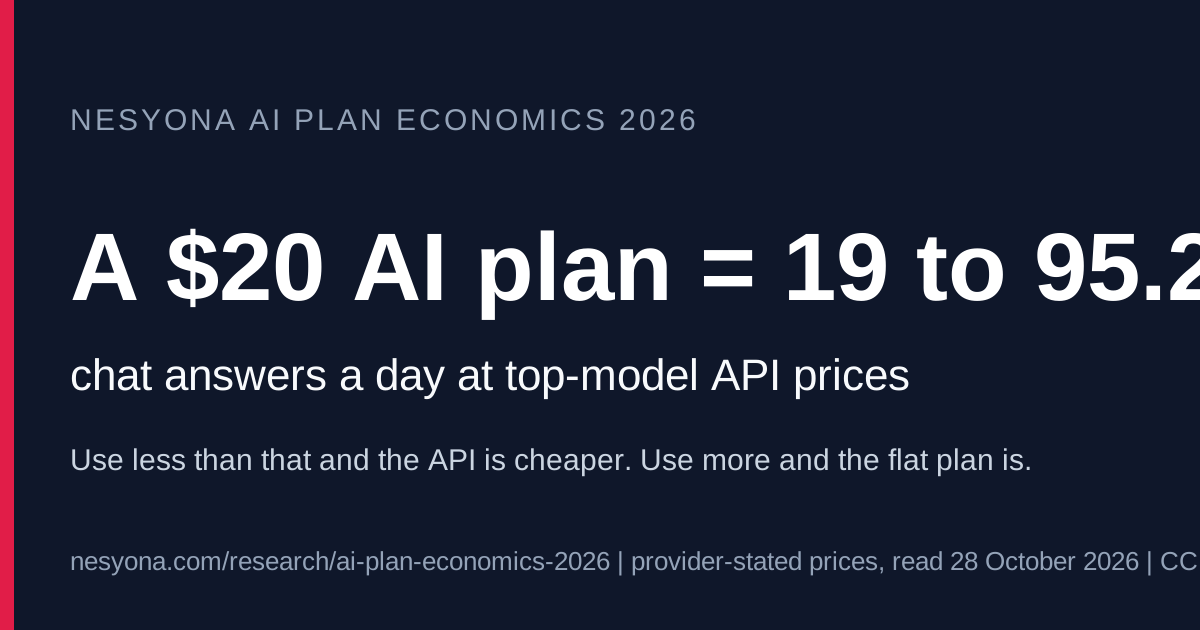
Built from the AI Price Watch files; the source hashes are in data.json under metadata.sources.
How to cite it
Couey, V. W. (2026). AI Plan Economics 2026: when a flat monthly AI plan stops being cheaper than the API. Nesyona. https://nesyona.com/research/ai-plan-economics-2026/ (data as of 28 October 2026). https://doi.org/10.5281/zenodo.23730057. To cite every version: https://doi.org/10.5281/zenodo.23730056.
How it is built, and what it does not cover
Plan price (plan-ladder.json, read from provider pages) divided by the cost of one task at an API reference point (cheapest, middle and highest-priced model on the provider's own pricing page, standard tier, USD per million tokens, archived with SHA-256). Break-even tasks per month = plan price / task cost; per day divides by 30. Cached input, batch discounts, tool-use fees and output-token reasoning are ignored.
- A plan is not an API. Plans bundle apps, memory, projects, tools and support, and providers cap usage in words the pages do not turn into numbers ("5x", "expanded"). The break-even says what the same money buys at list API prices, not which one to choose.
- Task sizes are declared assumptions. A real workload may use more input tokens (long chats resend history) or more output tokens (reasoning), and prompt caching can cut input costs a lot.
- Reference points are the cheapest, middle and highest-priced models on each provider's page, not a claim about which model a plan runs. Plans and their model access change.
- Prices were read on the dates shown, for the United States storefront, excluding tax. "From" prices are lower bounds.
- Mistral's plans are in the plan ladder but have no API price on file here, so they carry no break-even rows. Providers not read (Perplexity, xAI, Microsoft) are not covered.
A provider or reader who finds a wrong figure can tell us; we correct it and date the correction.
FAQ
How much AI does a $20 plan actually buy?
A $20 AI plan buys about 19 to 95.2 chat answers a day at the provider's top-model API list price, and about 95.2 a day at its mid model. Use less than that and the API is cheaper; use more and the flat plan is. The arithmetic uses each provider's own API list prices and three declared task sizes. It does not say which plan to choose: plans bundle apps, memory and tools, and cap usage in words the pages do not turn into numbers.
Is it cheaper to use the API than a $20 plan?
Only if you use less than the break-even for the model you would call. At the top model the break-even is roughly 19 to 95.2 chat answers a day; at a small model it is far higher. Set your own use in the calculator above. You also give up the app, memory, projects and tools a plan includes, and you take on running keys and a billing account.
Where do the prices come from?
From the providers' own pricing pages, parsed by pattern from saved copies with the SHA-256 recorded in the AI Price Watch dataset, and the consumer plan prices read from the provider pages on 2026-10-26, Chrome, US storefront. Prices are as displayed on that date and region; taxes excluded; they change.. Nothing is estimated from memory, and a model with no parsed price is left out.
Why are the model sizes small, mid and top?
The editor names one small, one mid and one top current model per provider and says so in the method. They are reference points for the arithmetic, not a claim about which model a plan runs.
What changes the maths?
Scheduled price changes the providers state in advance (listed above), prompt caching and batch discounts (ignored here), long chats that resend history (more input tokens), and reasoning output (more output tokens).
Can I reuse it?
Yes. It is published under CC BY 4.0: reuse is free with attribution to Vincent Wesley Couey and a link to this page.
Does it have a DOI?
Yes. Version 1 is https://doi.org/10.5281/zenodo.23730057. The DOI for all versions is https://doi.org/10.5281/zenodo.23730056.